“Best API for sex offender data in the USA” depends on what you’re building.
A law-enforcement platform, a regulated screening process, and a consumer-facing safety feature all need different things from sex offender registry data.
In this guide, we compare the main sex offender registry API options in 2026, using criteria you can validate from the outside: coverage, refresh cadence, deduplication, access model, pricing, and more.
How We Compare Sex Offender Registry APIs
On the surface, most sex offender registry APIs look similar.
They all claim nationwide coverage. They all promise up-to-date data. And almost all of them say they’re “API-ready.”
The differences show up only after integration. That’s why we compare providers based on what product teams actually deal with once the API is live.
We focus on the following:
- Coverage and updates Which states and territories are included, how often data is refreshed, and whether updates come with any visibility into what changed.
- Data quality How duplicates are handled, whether records are standardized across states, and how identity edge cases are explained.
- Geospatial data If the API supports radius-based geospatial search (lat/lng) search.
- Access model Whether the sex offender data is also available in other formats.
- Free testing If you can explore real responses before committing to a paid plan.
- Pricing Transparent, usage-based pricing versus sales-driven models.
This way, you’ll see how different tools behave in real products—and will be able to choose an API that matches how you plan to use the data.
A Table to Compare Sex Offender APIs
Not all providers disclose the same level of detail. When information is missing, we mark it as not disclosed
| Criteria | Nannostomus | Offenders.io | Crimeometer | InformData (SOR+™) | OffenderList | Family Watchdog |
|---|---|---|---|---|---|---|
| Coverage | Nationwide | Nationwide | Nationwide | Nationwide | Nationwide | Nationwide |
| Update cadence | Monthly + statistics | Daily | Not mentioned | Real-time access to 33 states | Not mentioned | Not mentioned |
| Data quality | Deduped within each state & field standardization | Not mentioned | Not mentioned | DOB and SSN logic for PII matching | Not mentioned | Not mentioned |
| Geospatial search | No | Yes | No | No | Yes | Yes |
| Access model | API + CSV | API + Batch processing | API | API | API + Batch processing | API + Batch processing |
| Free testing | 100 free requests/month | First 50 requests | 7 days free trial | Not mentioned | Per request | Not mentioned |
| Pricing | Pay-as-you-go | Per request | Subscription | Not mentioned | Package-based | Package-based |
Sex Offender Registry API Providers: Detailed Overview
Below are the main sex offender registry API providers that dev teams usually compare in 2025.
- Nannostomus — non-CRA sex offender data with free 100 requests every month
- Offenders.io — API-first sex offender registry access for basic lookup and enrichment
- Crimeometer — broad crime data API; sex offender data is not the main focus
- InformData — enterprise screening workflows with API access via SOR+™
- OffenderList — registry lookup service with API availability
- Family Watchdog — public registry platform offering API-based access
In the next sections, we’ll look at each option more closely.
Nannostomus
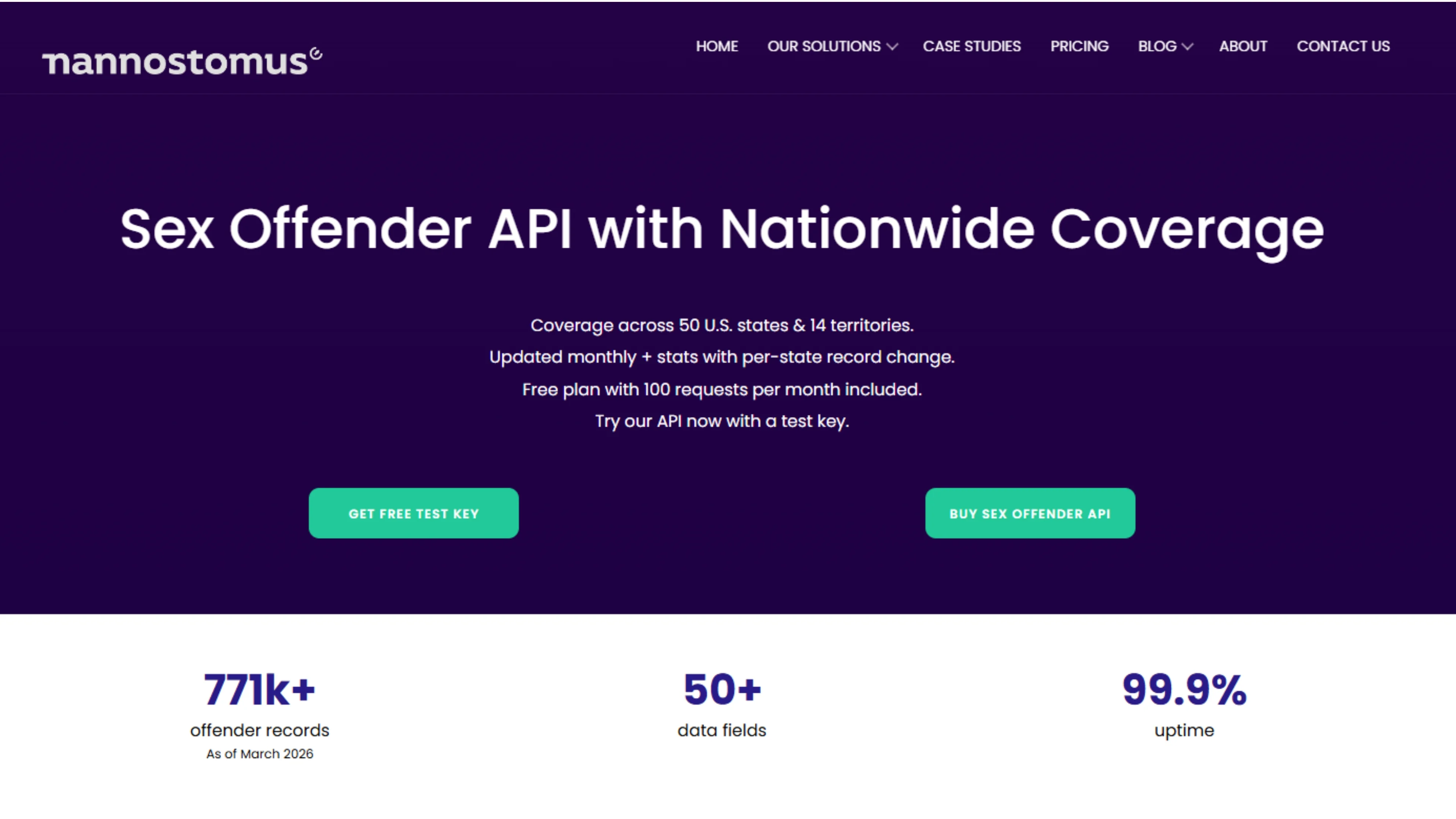
Nannostomus offers a sex offender registry API with full U.S. data. It’s built for product teams that use sex offender data as a non-CRA signal. The API is updated monthly, and each release includes statistics showing record count changes per state. Data quality is handled at the source level. Records are deduplicated within each state to account for multiple registries and inconsistent formats and fields are standardized where possible, which makes it one of the top sex offender data APIs.
Access is fully self-managed through a platform where you generate API keys, track usage, and download invoices without sales involvement. Pricing follows a pay-as-you-go model, and every account gets 100 free API requests each month, which makes it easy to test, monitor, and integrate the API into production workflows without upfront commitments.
Pricing:
- 0-100 requests - $0 per request
- 101-300 requests - $0.15 per request
- 301 - 3,000 requests - $0.10 per request
- 3,001 - 10,000 requests - $0.05 per request
- 10,001 - 30,000 requests - $0.03 per request
- $2,500 - Unlimited
Offenders.io
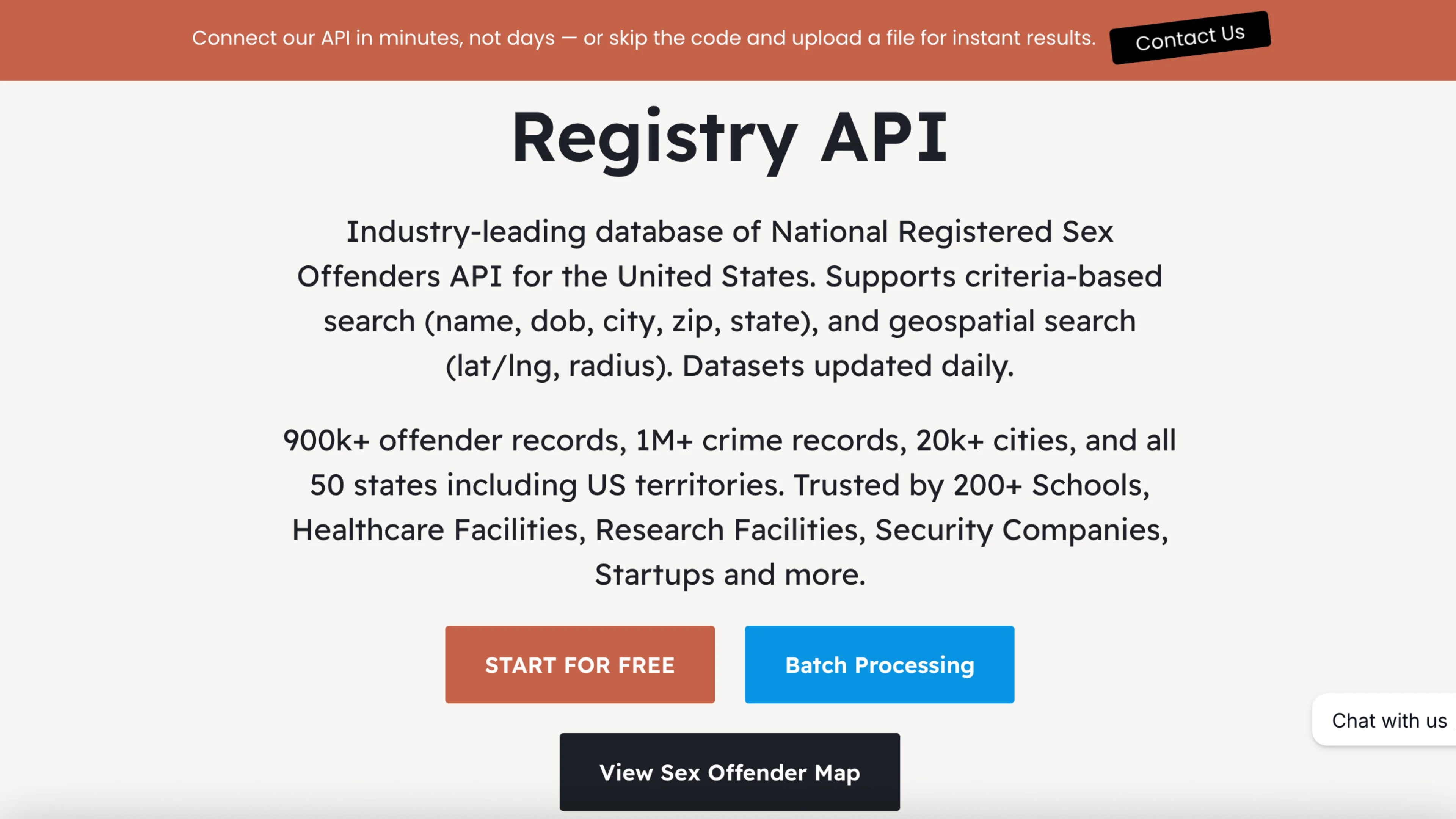
Offenders.io presents itself as an API-first service for accessing U.S. sex offender registry data. The API supports criteria-based lookups using name, date of birth, city, ZIP code, and state, as well as geospatial searches with native radius filtering. In addition to real-time queries, the platform also offers batch processing, which makes it suitable for running checks across larger sets of records.
At the same time, some operational details are not fully explained. While daily updates are mentioned, there is no public information about change tracking, update reporting, or how data consistency is maintained across states.
Pricing:
- First 50 requests - $0 per request
- 51 - 2,000 requests - $0.20 per request
- From 2,000 requests - $0.15 per request
Crimeometer

Crimeometer offers sex offender data as part of a broader crime intelligence API. According to their documentation, the API allows users to retrieve registered sex offender records across the U.S. using name-based and ZIP code–based searches. The endpoint structure is straightforward, and example requests are provided, which makes it relatively easy for developers to understand how to query the data once access is granted.
At the same time, several important details are not publicly specified. Crimeometer does not clearly state how often sex offender records are updated, whether updates are incremental or full refreshes, or how changes are communicated. There is no public explanation of deduplication, record standardization across states, or the depth of available offender fields. As a result, Crimeometer works best for teams that need basic registry lookups as part of a broader crime data stack.
Pricing:
- $400 for 500 requests
InformData (SOR+™)
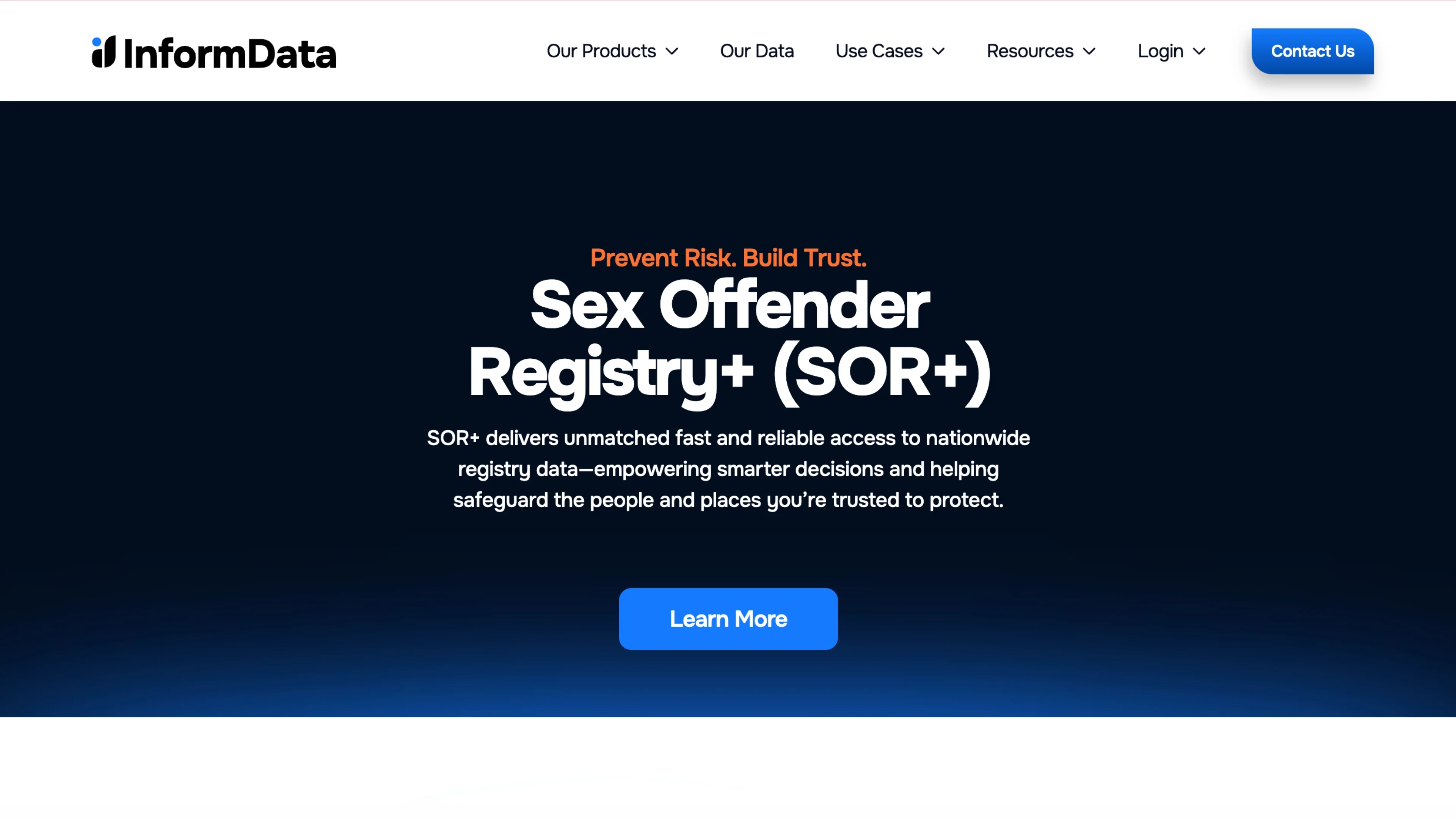
InformData SOR+™ is positioned as the most accurate sex offender API for regulated, high-risk environments. The product emphasizes broad coverage, claiming access to hundreds of thousands of records aggregated from thousands of law-enforcement and registry sources. InformData highlights direct state access through proprietary API connections and real-time scraping. A key focus of the offering is PII matching, where SOR+™ is marketed as reducing false positives through full name and SSN logic.
While API access is mentioned, the page does not describe the API structure, available fields, update cadence, or testing options. There is no public pricing, no free trial, and no documentation aimed at product teams. Instead, SOR+™ is framed as part of a broader compliance-oriented workflow used in healthcare, education, staffing, and other regulated sectors. InformData is a strong fit for organizations that need maximum recall and reduced false positives in regulated screening.
OffenderList
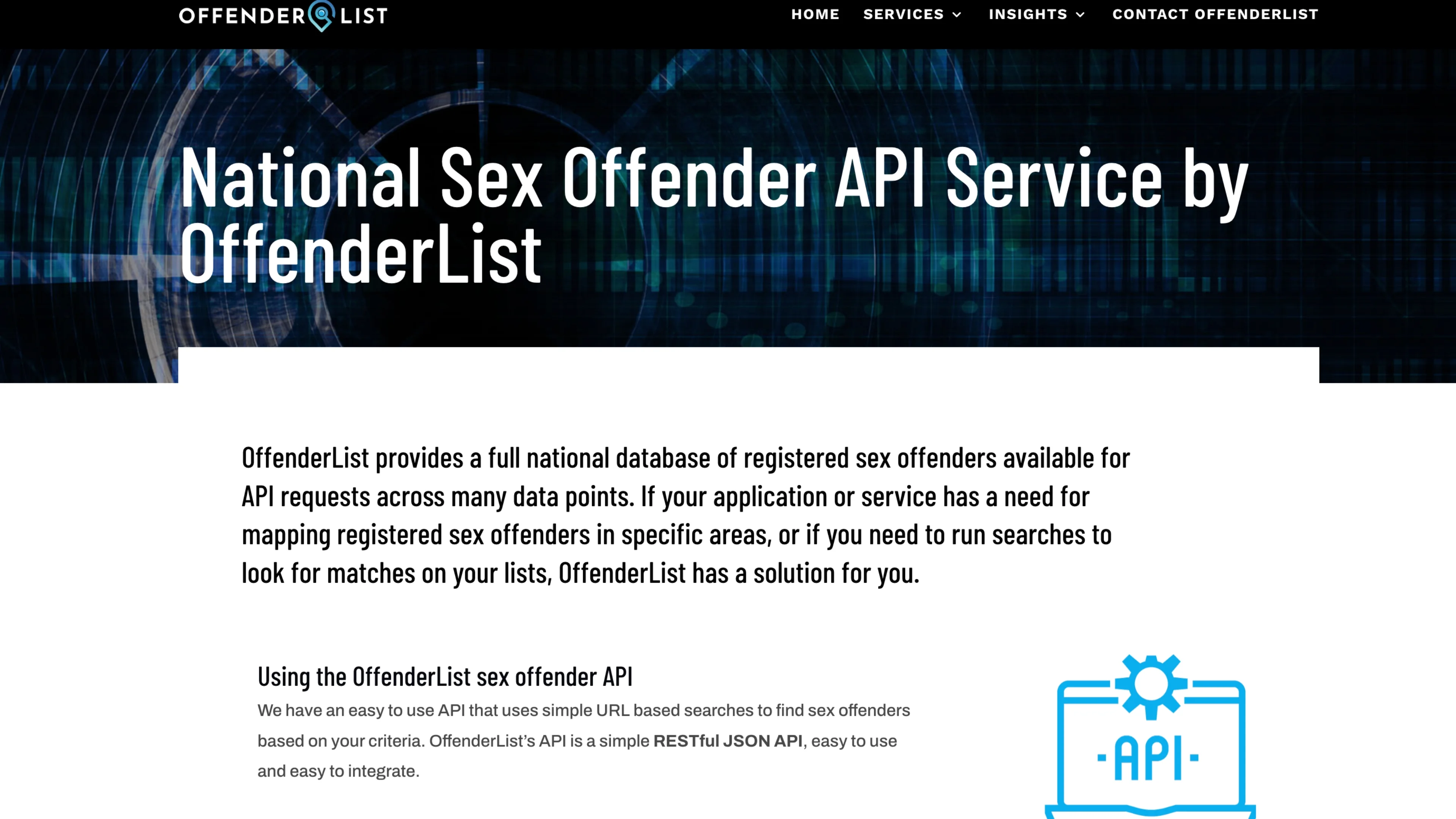
OffenderList offers a national sex offender API that’s designed around search and matching use cases. The API supports queries by first and last name, date of birth, city, ZIP code, state, and even latitude and longitude. This makes it suitable for applications that need to locate offenders in a specific area, map results, or check lists of names against registry data. The API is REST-based, returns JSON, and is positioned as easy to integrate.
The service also exposes a fairly detailed set of offender attributes, including physical characteristics, address information, images, and case details. Pricing and access, however, are handled through a request-based process. Update frequency, data refresh mechanics, deduplication rules, and standardization across states are not described on the page. OffenderList works well for lookup-heavy or batch-style matching scenarios.
Pricing:
- Not publicly available
Family WatchDog
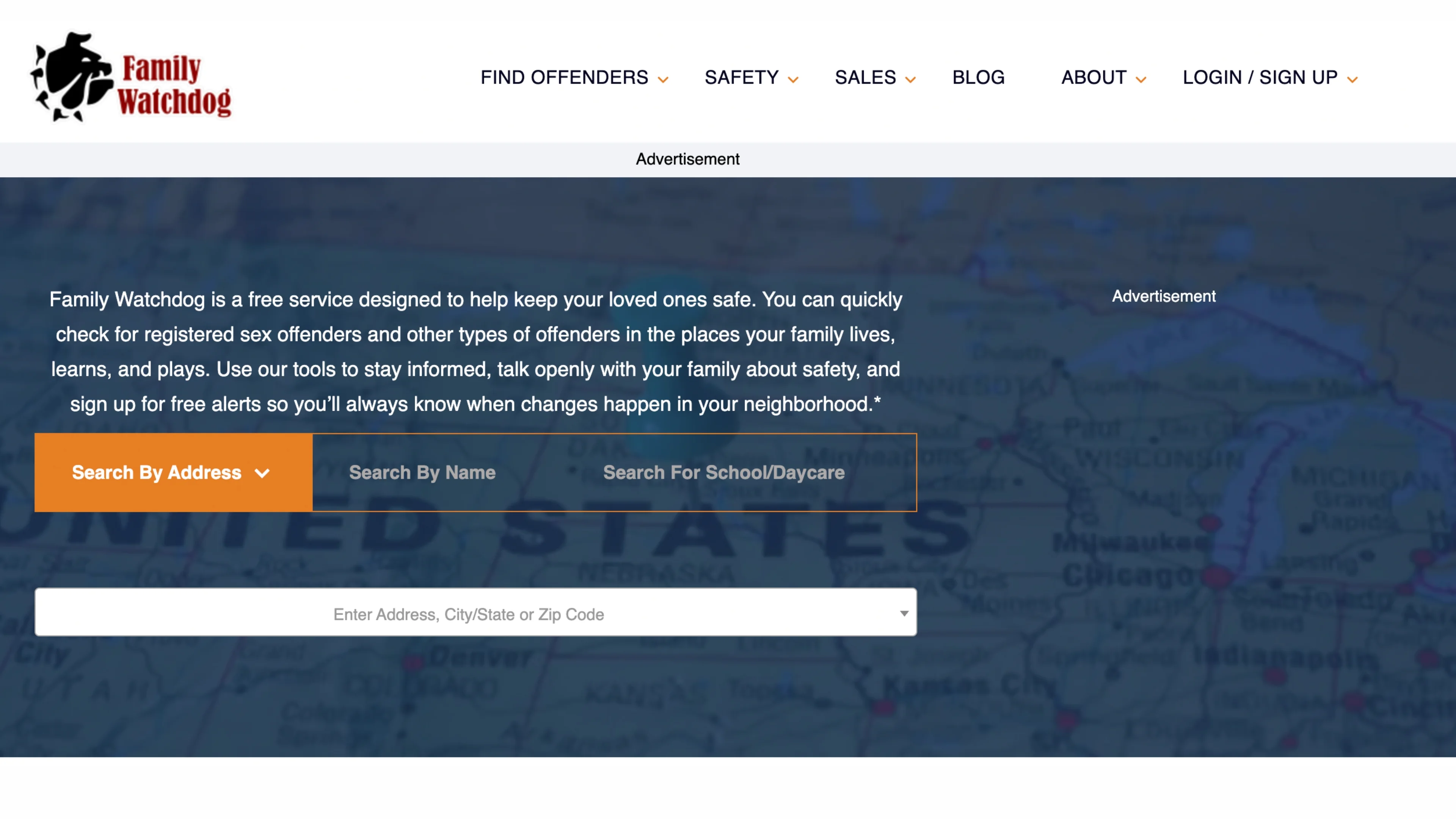
Family Watchdog offers a JSON/XML REST API that’s clearly designed around search and display use cases, especially maps and proximity-based views. The API supports queries by name, date of birth, state, ZIP code, and geographic bounds, and it also exposes individual offender records and images. There are a number of optional parameters: nickname matching, wildcard search, and “lite” responses—that make it flexible for simple applications. Compared to some newer tools, the API feels very explicit and low-level, which can be a plus if you want tight control over how searches behave.
At the same time, the service shows its age in how it’s positioned and documented. Access is handled through direct purchase or contact. Update frequency isn’t stated, and there’s no information about deduplication, data normalization across states. Pricing is published and straightforward, but testing options are limited to paid packages. Family Watchdog works well for basic lookup tools and map-based displays.
Pricing:
- 500 requests - $75 per package ($0.15 per call)
- 1,000 requests - $140 per package ($0.14 per call)
- 5,000 requests - $600 per package ($0.12 per call)
- 10,000 requests - $1,000.00 per package ($0.10 per call)
Which sex offender API is better?
There isn’t one “best” sex offender registry API for every use case. The right choice depends on what you’re building and how the data fits into your product. Some top sex offender API providers work best for regulated screening and decision-making in high-risk environments. Others focus on simple lookups or location-based searches. And some are built for developers who need predictable access, clear pricing, and the ability to test before committing.
If you’re building a non-CRA product—like a people search platform, a dating or ride-hailing safety feature, a trust score, or an identity risk signal—developer-first APIs with transparent access models tend to work best. In those cases, visibility into updates, clear data handling rules, and flexible usage matter more than enterprise screening workflows. The best API is the one that matches your product’s reality, not just the size of its dataset.