If you need sex offender registry data for your product, one of the first questions is usually technical:
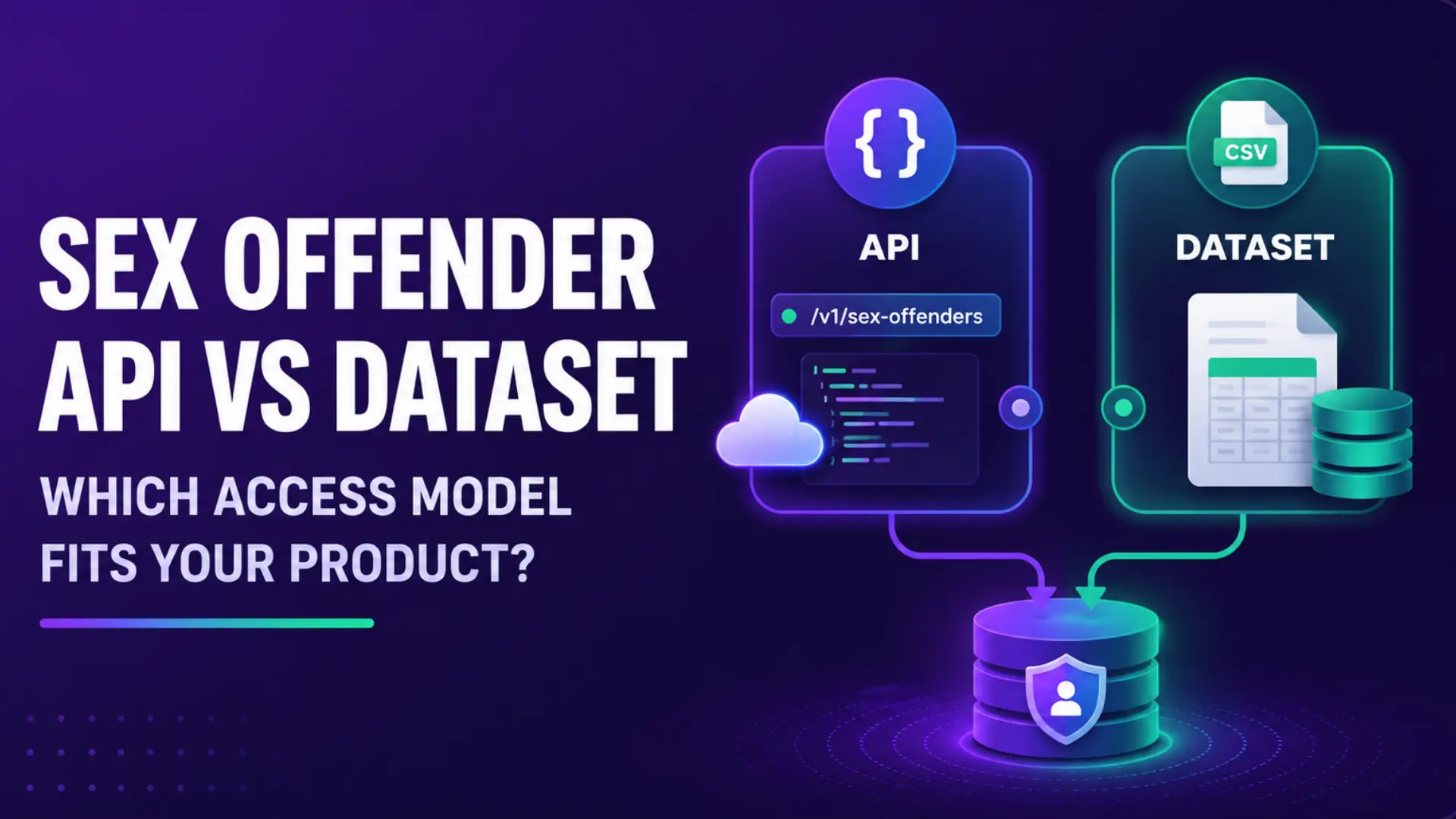
Should you use an API or receive the dataset as a file?
The answer depends on how your product will work with the data. And in this article, we’re going to look into which access model makes more sense for your software or app.
Same Data, Different Access Models
Before you compare an API with a CSV dataset, it helps to clarify one thing first.
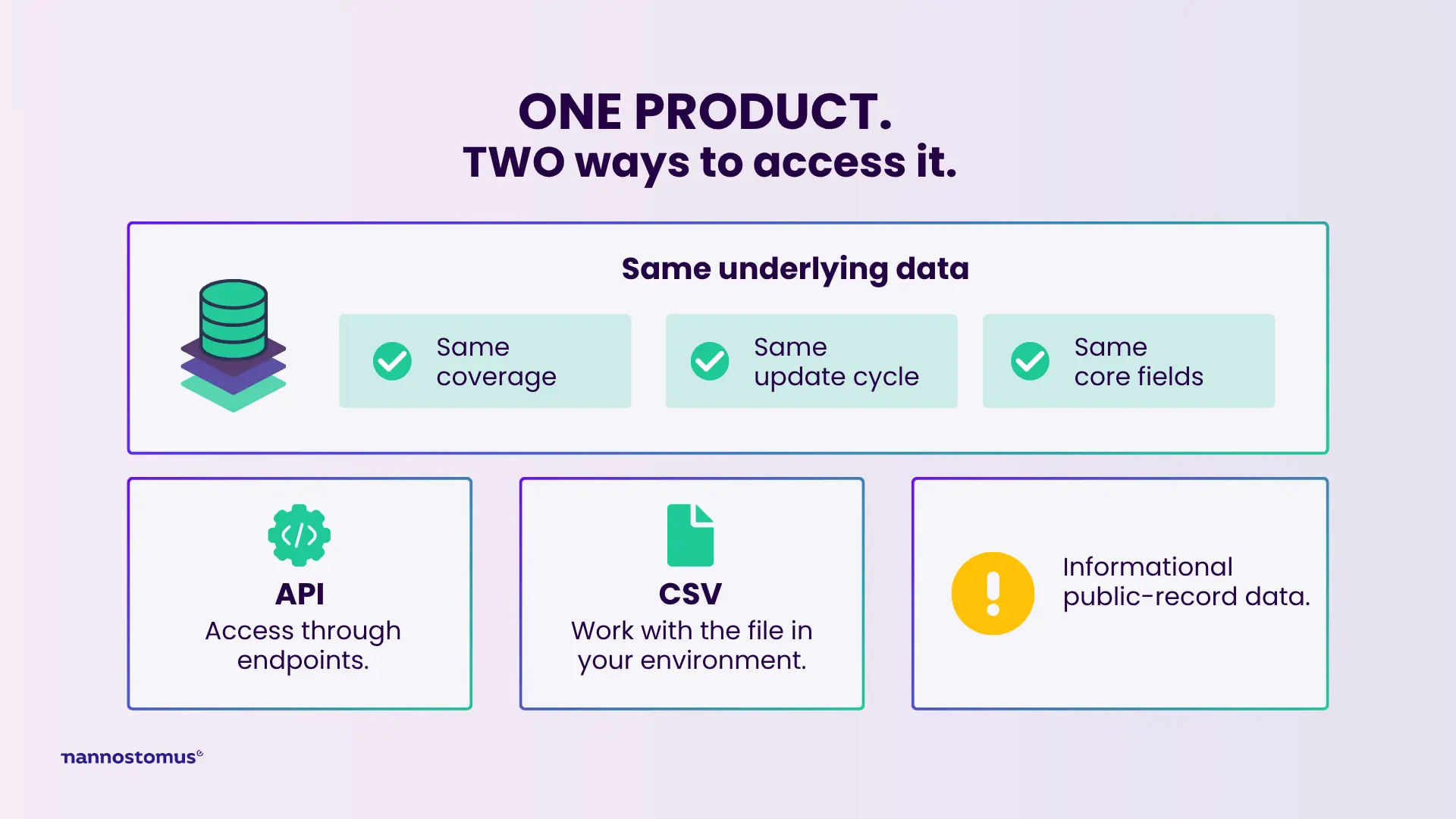
You are not choosing between two different data products.
In this case, the API and CSV dataset rely on the same underlying sex offender registry data. The coverage is the same. The refresh cadence is the same. The core fields come from the same data asset.
What changes is how you access that data.
With an API, your product can request data through endpoints. With a CSV dataset, your team receives the file and works with it inside your own environment.
The same limitations also apply to both formats.
Sex offender registry data should be treated as informational public-record data. It can support research, product enrichment, public-record search, and broader data workflows. It should not be treated as a ready-made tool for employment, tenant screening, credit, insurance, or other formal eligibility decisions.
Before you choose either access model, evaluate the data fit, known limitations, and downstream use inside your product.
When a Sex Offender API Is the Better Fit
A sex offender API is usually the better choice when your product needs to request data at the moment of use.
That may be a person search, a profile check, an internal lookup, or another workflow where your system only needs the data after a user or process triggers the request.
This matters when you do not want to download, store, and process the full dataset before you know how often your product will use it.
For example, your team may want to add sex offender registry data as one signal inside a broader public-record, people-search, research, or safety workflow. At this stage, you may not know the expected volume yet. You may also need to test how the response structure fits your existing product logic before making a bigger commitment.
An API gives your developers a faster way to start.
They can review the endpoints, inspect the response, test real calls, and decide whether the data is useful for the workflow you are building. This is especially helpful when the use case is still new, the request volume is uneven, or the product team is still deciding how visible this data should be inside the user experience.
From a business point of view, API access lowers the cost of being wrong.
You can test the data layer without setting up monthly file ingestion, storage, internal processing, or a broader data pipeline first. If the data fits, you can keep building around it. If it does not, you have learned that before turning it into infrastructure.
API access also works well when your team wants a simpler commercial start. With self-service key management, free monthly calls, and usage-based pricing, you can begin with a smaller setup and expand only when usage justifies it.
Choose the CSV Dataset When the Data Becomes Part of Your Infrastructure
A CSV dataset makes more sense when you already know your product needs the data on a recurring basis.
At this point, you are not only testing whether sex offender registry data is useful. You are planning to make it part of your data stack.
That usually means your team wants the file delivered into its own environment. You may need to load it into S3, Google Cloud Storage, Azure Blob, FTP/SFTP, a warehouse, or another internal system. From there, your team can process it, join it with other datasets, build search indexes, run analysis, or make it available to several workflows.
This is where CSV becomes more useful than live API calls.
It gives your team more control over how the data is stored, normalized, queried, and reused. You can run your own matching logic, enrich internal records, support offline analysis, or prepare the data for broader public-record, research, or people-data products.
Sex offender data in CSV is usually the better fit when:
- You want the full file in your own storage
- Several teams or systems will reuse the same data
- You need bulk ingestion or warehouse loading
- You want to build your own search or matching layer
- You prefer predictable monthly delivery over request-based access
With a CSV dataset, you are taking ownership of the file after delivery. Your team needs to handle storage, ingestion, processing, access control, and internal use rules. That makes sense when the data is already valuable enough to become part of your infrastructure.
From a business point of view, CSV works better once the need is clear. You are no longer asking, “Should we test this signal?” You are asking, “How do we make this data available across our system every month?”
That is why CSV is the stronger model for teams that want predictable access, internal reuse, and more control over how the data supports their product.
Sex Offender API Pricing vs CSV Dataset Subscription
The commercial difference between API and CSV follows the same logic as the technical difference.
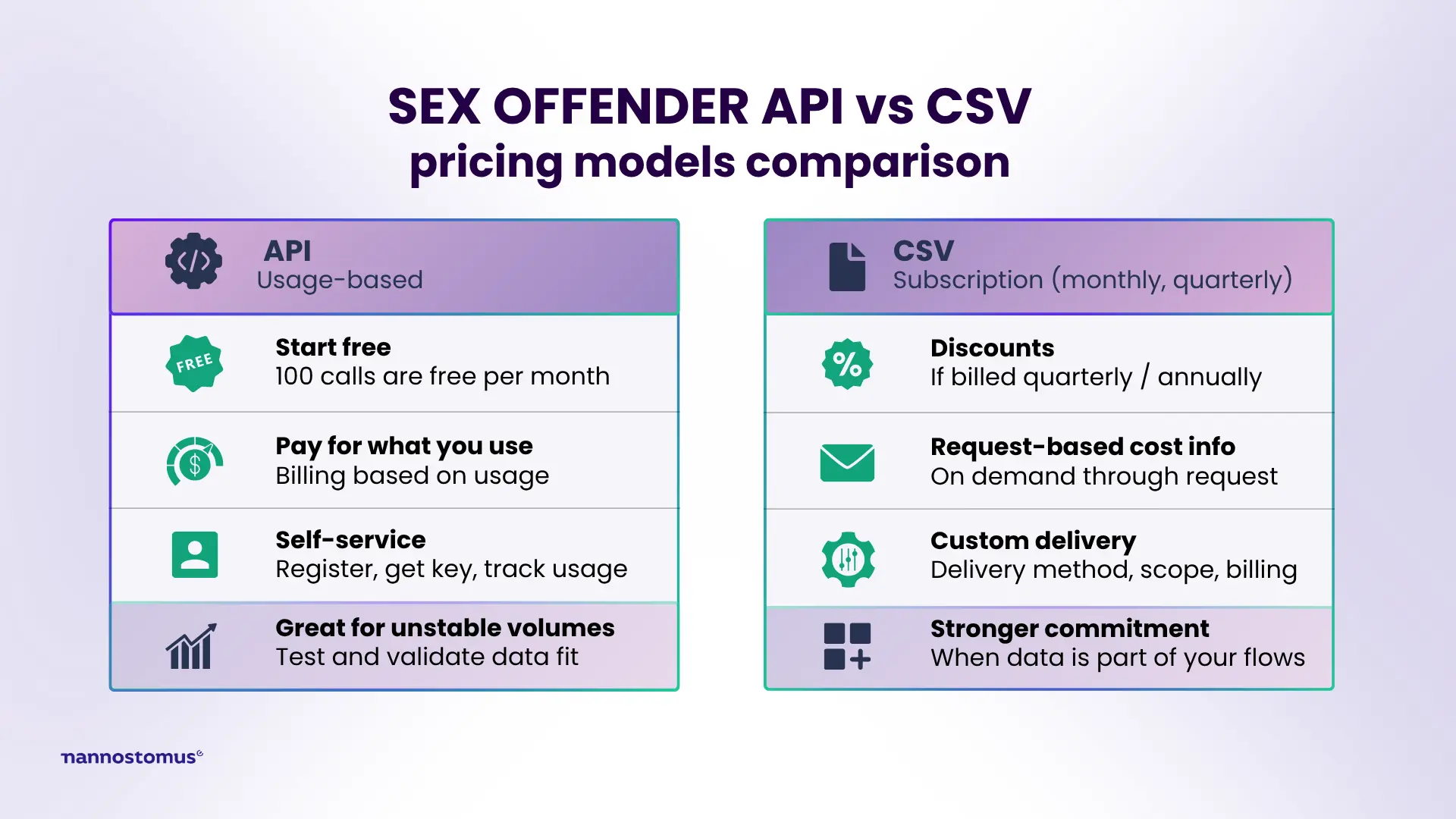
API pricing works better when you want to start small, test usage, or keep costs tied to actual requests. You can begin with 100 free requests per month, then pay for additional calls based on usage. This makes API access a better fit when volume is still unclear or when your team is testing whether sex offender registry data belongs in the product.
CSV is a different buying model.
With CSV, you are not paying per lookup. You are paying for recurring access to the dataset as a delivered file. CSV pricing is typically handled through a request-based sales process. That fits the way CSV is used: the buyer often needs to discuss delivery method, scope, billing terms, storage destination, and internal data handling before starting.
API vs CSV Dataset: Side-by-Side Comparison
Once you understand that API and CSV rely on the same underlying data, the choice becomes easier. You are not comparing coverage or refresh cadence. You are comparing how your product will access the data, how much control your team needs, and how ready you are to make the dataset part of your system.
| Question | API is usually better when… | CSV dataset is usually better when… |
|---|---|---|
| How do you want to access the data? | Your product needs to request data through endpoints. | Your team wants the file delivered into its own environment. |
| Are you still testing the use case? | Yes. You want to validate fit before setting up a larger data workflow. | No. You already know the data belongs in your product or operations. |
| What does your workflow look like? | Lookup-based: search, profile check, internal query, or triggered request. | Bulk-based: ingestion, storage, processing, joins, or internal reuse. |
| How predictable is your usage? | Usage is unclear, uneven, or still growing. | Usage is expected to be recurring and stable. |
| Who mainly works with it? | Developers or product teams testing or integrating access. | Data, engineering, or analytics teams managing internal data flows. |
| Do you need to store the full dataset? | Usually no. The API is useful when you do not want to handle the full file. | Yes. CSV is useful when the dataset needs to live in your storage. |
| How will pricing usually work? | Usage-based: start with free monthly requests, then pay for additional calls. | Subscription-based: recurring access to the delivered dataset. |
| What is the main trade-off? | Less setup, but more dependence on live API calls. | More control, but more responsibility for storage and processing. |
| Best fit | Testing, product integration, lookup access, and early validation. | Internal infrastructure, monthly ingestion, warehouse loading, and reuse across systems. |
Final Recommendation: Choose by Workflow
A sex offender API is usually the better starting point when you need lookup access, quick testing, or a lighter way to add registry data to your product. It helps you validate the data layer before you build a larger internal process around it. If API access fits your workflow, review the sex offender API, test the response, and check current usage-based pricing.
A CSV dataset makes more sense when the data has already become part of your infrastructure. If your team needs monthly delivery, internal storage, bulk processing, warehouse loading, or reuse across several systems, CSV gives you more control. You can test the sample of sex offender CSV dataset by loading it from the product page.
The right choice depends on how your product will use the data — not on which format sounds more advanced.